Sunday, June 21, 2020

Poudre Canyon - Covid summer, chapter 1


In early June, Sandi and I drove up the Poudre Canyon to scout campgrounds. At Kelly Flats, next to the Poudre River, the campground host suggested that we show up Wednesday morning if we wanted a campsite, as it is first come first served. It has been a busy summer in the Poudre Canyon campgrounds, so it takes strategy to get a good campsite. The campgrounds just opened June 1st, and people have been feeling cooped up and wanted to get out.
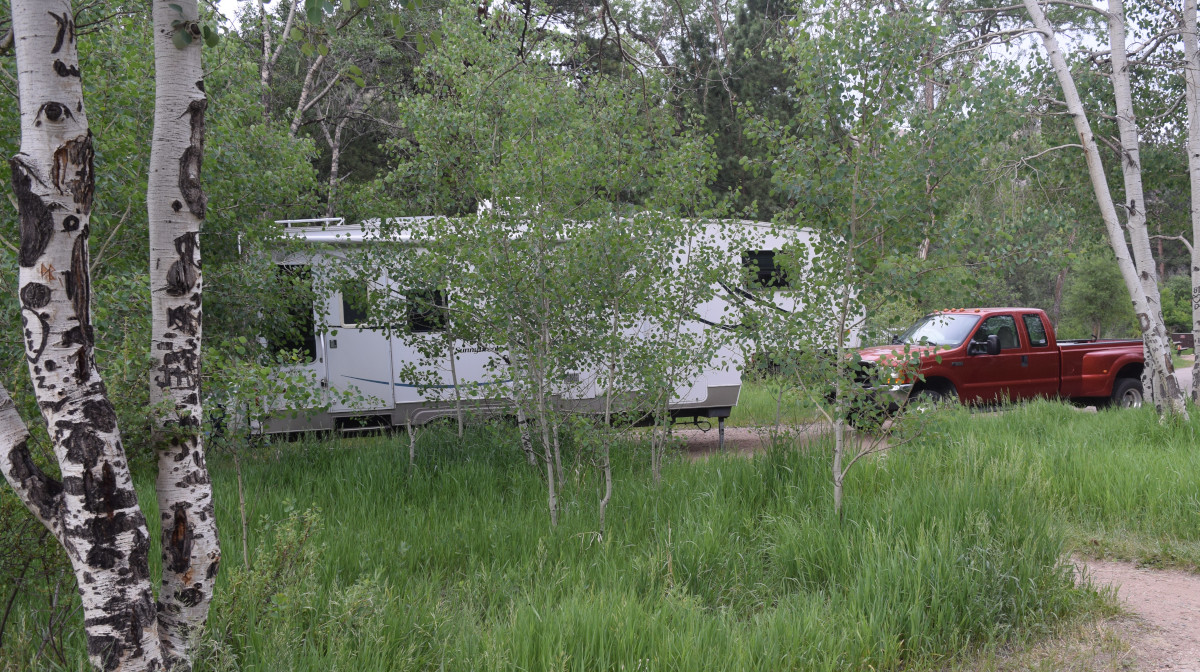
On June 17th, we drove to Kelly Flats campground, and spoke to the campground host. She told us who was leaving that day, and we chose one of those sites. We waited an hour or so before they left. The campsite was right next to the river, at the end of a cul-de-sac, so an excellent campsite.


We decided to head up the canyon, and stopped at Glen Echo Resort, where we had hamburgers outside. We continued up the canyon to Long Draw Road, where we hoped to drive up and find the trailhead to the ghost town of Lulu. However, the road was gated closed, so that was not going to work. We instead walked on the Blue Lake Trail. We did not walk all the way to Blue Lake, but we did get some views of Chamber's Reservoir. The creeks and rivers are running high. The photo of Sandi was taken at one of the creeks; I was experimenting with longer exposures to get artistic photos of water.

Small Rainbow Trout
On Thursday the 18th, we headed up to Chamber's lake to go fishing. When we parked, the map showed a smaller lake nearby, called Lost Lake. We took a short hike to Lost Lake. Sandi practiced with her new rod and reel. Richard caught and released a couple of small rainbow trout. It was cold, so we knocked off after a couple of hours, and headed back down to the camper. We worked on our relaxing. Sandi cooked salmon for dinner.


Friday the 19th, we again headed for Chamber's Lake. This time we walked past the closed gate, to the campground. We started to fish, but the thunder got closer, so we headed for the only available shelter, the porch of the campground pit toilet.
We saw rain and sleet, and were glad to be out of the weather, while we ate lunch. After the rain stopped, we resumed fishing. Richard caught and released about five 8 inch rainbow trout. Sandi continued practicing, and had a couple of nibbles. We scouted the campground for future reference, and saw that it was very good. We walked back to the truck, and headed down the canyon, taking a photo at Poudre falls. We stopped at Archer's resort, which had a little of everything, including the fishing lure that I was looking for; Archer's is similar to Glen Echo, but with lower gas prices.

Sandi grilled Italian sausage outside; the leftovers will be used as part of a pasta dinner on Saturday.

Columbine - Colorado State Flower

There are about twenty butterflies in this photo.

On Saturday we took a hike up Dadd Gulch. The trail follows the small stream. There were literally hundreds of butterflies near the stream, I am only including two photos out of many that I took. The columbines were also gorgeous. The hike was pleasant but warm. There were quite a few parties on the trail, as this is not far from Fort Collins. Saturday night we had a campfire.

Sunday we got up early so we would not miss our ancient Greek class, via Zoom.

Thursday, January 16, 2020

San Antonio


On Monday morning, we pulled out of Port Aransas in a misty rain, and headed north on I-37. The rain continued throughout the day and evening.

San Jose Mission
We found our RV campground, dropped the rig, and drove to the San Antonio Missions National Historic Park. We started at the visitor center, and took a walking tour with a ranger. The San Jose mission is large and impressive, including some excellent stonework. These missions are about 300 years old, and were in operation for about 100 years, converting Indians into Spanish Citizens and Catholics. We drove to the small San Juan mission, and then walked along the river to the Espada mission. All in a drizzle.

We had dinner at theYard House pub, where the national college football championship game was on the TV; we had to ask who was playing. The food was good, and they had 170 beers on tap. Our waitress had just returned from Telluride, and was considering a move to Denver.

Everything is damp, it seems, nothing is drying. We thought about turning up the heat to dry things, but the outside and inside temperatures are about the same. The forecast for tomorrow is more rain. We hope that we don't mildew.

Alamo

Wednesday started out drier, and we headed downtown. We decided to get a bus pass and use the bus that runs in front of the campground, to avoid parking hassles. Our first stop was the Alamo, which Sandi had never seen. We then headed to the riverwalk, where we ate at Casa del Rio. About that time the sun came out, which we were very happy to see. After a bit of walking on the riverwalk, we headed for La Villita, a craft and shopping village, where we spoke to interesting people, and Sandi bought earrings. The copper store was run by a family from Micheoacan; most of the family has left Micheocan due to the violence and insecurity there.

We stopped at Mission Conception on the way back to the campground, completing our circuit of 5 missions, including the Alamo.

After resting in the camper for a while, we headed for the free evening at the San Antonio Art museum, which included many antiquities from all over the world, in addition to art. We had a nice dinner at their restaurant, overlooking the river.

Thursday, January 9, 2020

Houston


I bought a new battery Friday morning, and we headed south on I-45 towards Houston. The scenery was wooded, unlike the high plains in the panhandle region. The traffic in Houston was intense, and the drivers are aggressive, so a challenge with a large vehicle. We found our campground, the Highway 6 RV park, which was quite nice. We paid a bit extra to get a site on the lake.

After we got settled, we headed the Brazos Bookstore, a local institution, and bought a few books. Then we drove to Ryan's bar, Darwin's Pub. We ordered food and beer, and waited for Ryan to arrive; it was good to see him. Ryan describes the pub as a five star dive bar, and explained how he runs the place, with many activities and events. They don't open until 4 PM; many of the clientele are waiters and servers, who want to relax with their friends after work, so it is a late night crowd.


On Saturday, we headed to the Johnson Space Center, which has many artifacts, the most impressive of which was a 747 jetliner with a shuttle on top. The jetliner was used to return the shuttle to Florida after it landed in the California desert. The visit to the restored Apollo mission control room was memorable, with a simulation of the first moon landing. The mission had to change landing sites on the fly, and had only 17 seconds of fuel left by touchdown. Of course, we remember the 1969 moon landing, so this was very meaningful to us.

We then visited the San Jacinto Battlefield and Memorial, which is slightly higher than the Washington Monument in DC. We did not elect to take an elevator to the top. The monument commemorates the victory of the Texans over Santa Anna, who was taken captive, in 1836. This battle gave the Texans their independence, and led indirectly to the Mexican-American war of 1846. This was an important part of US history, since that war resulted in Mexico seceding California and most of the west to the US. The battleship Texas is located nearby.

We had dinner on the picnic table next to our camper, as it was not too cold with jackets on. We did not need a jacket during the day, which was quite pleasant.

On Sunday, we went to church at St Catherine of Sienna in Houston. The priest was a very funny Irishman. The gospel was the Three Wise Men, but he reminded us that the scripture does not say if there were three wise men or some other number, or even if they were men or women. We were drafted to bring up the gifts, and he joked that maybe there were two wise men (us).

After mass, we went to Goode Company Barbecue to take out lunch. The décor was 100% Texas, down to the stuffed bison with a saddle. ;-) We headed to Ryan's house, where Sandi met Cindy, and we both met Orren, about three months old. They have a cute house that they bought a couple of years ago. We had a nice visit, and then headed back to the campground.


Saturday, January 4, 2020

Driving South – Palo Duro State Park and beyond


On Monday December 30th we got on the road about 8, and drove southwest through Limon and Lamar. It was sunny but cold, with a strong breeze; the highway department had wind warnings for high profile vehicles, but for us it was mostly a tailwind. After crossing the panhandle of Oklahoma, we stopped for the night in Dalhart Texas. Our GPS sent us on the wrong side of the railroad tracks; after bouncing for a while on the dirt road in the dark, we were able to get turned around and head back to the main road.

On Tuesday, we got a slow start, including wandering through Dumas Texas, looking for cheap gas and a propane fill. We drove through Amarillo to Canyon, where we ate at Feldman's Wrong Way Diner, a local institution, where each table had a different theme. We sat at the UFO and Area 51 table, and watched the G-scale train go overhead around the restaurant. 

The Panhandle Plains museum was huge, with exhibits on oil, firearms, the settlement of the area, paleontology and more. Note the photo of the Allosaurus with the Santa hat.


We proceeded to the nearby Palo Duro State park, where we were fortunate to have a camping reservation, as all the campsites were booked for New Year's Eve. We will need to change campsites tomorrow, as someone else has this site tomorrow. Palo Duro Canyon is beautiful. We bought a couple of books about the area. We enjoyed looking at the stars and listening to the coyotes howl. 


On New Year's Day, hiked on the Paseo del Rio trail, following the Prarie Dog Fork of the Red River, a casual hike on a warm but windy day. 

On Thursday we headed for Dallas on US287. The drive was routine. We are staying in a campground on the edge of Dallas, apparently the only overnight guests in the place.  Everyone else was a longer term visitor.  Our truck has stalled twice today, not normal behavior. When the guy at O'Reilly hooked up his test equipment, about the only thing he saw on the error log was low voltage. But when he tested the battery and alternator, it checked out. We had a problem starting it a couple of weeks ago, after leaving it on for hours while I was working on the trailer wiring. The battery is almost four years old, so we will probably replace it, and hope that solves the issue.

Wednesday, November 13, 2019

Lima, the Larco Museum, and Home

We arrived late to our hotel, the Casa Bella Boutique Hotel in Miraflores neighborhood. We were beat. We slept in, and had breakfast with a couple from Guelph, Ontario. They were surprised that Sandi knew their town. They had missed their flight, as the flight time had changed without them being notified. We and they decided to pay for an additional night to allow ourselves a place to rest before our late flight back to the USA. We changed to the Hotel Faro nearby. We went to the Cathedral on the main plaza, which was closed as part of a ceremony to had over new fire trucks and ambulances to the firemen. The Cathedral was somewhat interesting, really a museum. We liked better the working church of Santo Domingo, where we saw petitions that people had put into the glass boxes that held statues, a kind of mailbox to God. Unfortunately, we ran out of time to see the museum in Santo Domingo. We took a taxi back to the hotel, and rested some. We then took a taxi to the Museo Larco, which was quite wonderful.

The beautiful grounds of the Larco

The Museo Larco is a private museum, a collection of an anthropologist and his wealthy father. The artifacts were of high artistic quality, and the explanatory text was on the big picture, rather than giving us detailed information about each artifact. Rather than focus on the well known Inka culture, it covered many of the cultures that preceded that Inka, such as the Moche, Nazca, and Pucara. We got a sense of the common elements of the native religions. The textiles and metal work were especially impressive. This was an excellent museum, with beautiful grounds. We had a snack in their restaurant, and then headed back to the hotel.

Hilary picked us up at the hotel, and took us to the airport. Our flight left Lima at 1 AM. The flight to Atlanta was routine; we arrived at about 8 AM, and headed for the Delta Club to await our flight to Denver.

Tuesday, November 12, 2019

Condors and Arequipa


Vicuna and Alpaca
On Sunday, Jorge picked us up in the hotel, in a van with a driver, Antonio, and we headed out into the Altiplano. We got up to about 15,000 ft elevation, and saw more alpacas than we believed possible. We also saw some vicuna, which we had not seen before. They made us think about the Pronghorn antelope in Wyoming, especially because the landscape reminded us of Wyoming.

Blanca also pointed out the Vizcacha rabbit, with its curling tail, which lives in the tundra.
Vizcacha, a large rabbit with a long tail.
Our driver had a problem with the van, which he resolved by adding water to the radiator. We stopped after the turnoff to Chivay to drop off Jorge, and pick up Blanca, who will be our guide until we leave Arequipa. We strolled into the main plaza of Chivay, and had a good dinner at the hotel. The Casa Andina hotel has a rustic feel, and includes a planetarium, but unfortunately it was cloudy. Many of the streets are dirt, but the plaza and the main road have recently been refurbished with a government grant. There are many hostels, but the Casa Andina may be the high end place in town. We had a good dinner at the Casa Andina.

On Monday, Blanca and Antonio picked us up at the hotel, and we headed for the Cruz de Condors, the overlook. We stopped first in Yanque, where we watched students folkloric dancing to raise money for school. 


When we arrived at the Cruz de Condors, we saw condors almost immediately. At one point, we could see four condors at one time. There was a crowd of tourists there, but Blanca pointed me to a good seat on a rock. Most of the condors were immature, but one was partly mature, with a white neck.


We headed back to Chivay, and walked through the market. Sandi bought a hat from a lady with an old Necci sewing machine; she freehand sewed designs on hats.

We headed for Arequipa, stopping at the pass at 4900 meters, about 16,000 feet. As we got closer to Arequipa, we were somewhat horrified by the dusty squatter neighborhoods, which looked very unattractive, and seemed to last for an hour or so. We finally arrived at the main plaza and Casa Andina Select hotel, a noticeable step up from the Casa Andina standard hotels that we used in Puno and Chivay. We had a decent pasta dinner at Lokanta, where we met yet another waiter from Venezuela. This had become a thread running through the trip, that many waiters were from Venezuela, fleeing the economic collapse there.

An escribino typing a letter in the square.  A dying occupation of old men.

On Tuesday, Blanca picked us up at the hotel, and we visited the Cathedral and the Monastery of Santa Catalina. When it was first founded, the Monastery (convent) was for daughters of rich families, who paid a dowry to join, and were permitted to have servants and live in a kind of apartment. The Monastery was like a city within the city, with roads, a plaza, a garden, and a mortuary. The Dominican nuns are still there, living in a portion of the monastery; the area we toured had been restored for tourism. We had a good tour from one of the guides of the monastery.

Blanca and Antonio took us to the airport. Our Latam flight to Lima was somewhat late; Sky, the local low-cost airline, had a kind of revolt after their flight was delayed; a loud guy was organizing the passengers to demand a meal as compensation.

Thursday, November 7, 2019

Lake Titicaca and Puno


We got up very early to leave the hotel around 6. Alvaro met us at the hotel, and took us to the Inka Express bus station. There were only 9 people on the bus, two Poles, two French, two German, and one Taiwanese lady. The bus had a driver, a tour guide, and a host/hostess.


Our first stop was at a very elaborate small church in Andahuaylillas. They promote it as the Sistine Chapel of the Americas, but this is greatly overstated. There are somewhat primitive murals, including one showing the route to heaven and the route to hell, as well as drawings of the saints. This was built during the evangelization period by the Jesuits, and the drawings were intended to teach the gospel to people who did not speak Spanish and could not read or write. We were not allowed to take photos, so I pulled one from the web.

Our second stop was at the somewhat interesting ruins of Raqchi, very different from what we had seen in the highlands, generally ruins with stone bases and adobe brick above.

The landscape changed to pure altiplano, a wide valley with brown grass, surrounded by mountains, and sometimes a small village. It felt a lot like parts of Colorado, such as the San Luis Valley.

The top of the pass was rainy and blowing hard, 14,300 ft elevation. There were other more forgettable stops. We were glad to arrive in Puno. Our guide, Jorge, sent a driver to pick us up, and met us at the hotel. We took a short walk to La Casona for dinner, and went to bed early. Richard had not felt well, so the early bedtime was welcome.

We saw groups of people in various cemeteries along the way, apparently for the day of the dead celebration, which is a holiday in Peru.


On Saturday morning, Jorge and a driver picked us up, and we took the boat to the floating islands of Uros. We visited one of the floating islands, where the president of the ten person island demonstrated how the islands were made. He invited us into his house, which was very small, with solar lighting.
We bought an embroidered piece, ducks in a blue theme, and took a ride on a reed boat to one of the larger islands. Richard got to row the boat. It was a touristic, but nice experience.


Then we went on the island of Tequile. The hike had about a 500 ft gain in elevation, to the main village, on a good stone trail. We visited the textile cooperative, where Sandi bought a doubleweave belt. Their textiles had bright colors and was made of acrylic. We had lunch at a family restaurant, where they demonstrated a folkloric dance, and also their knitting, which is very fine and very fast, including a hooked needle to facilitate working with the fine fibers. The hike back to the boat was very steep, and we were the last ones on the boat.


Rather than go back to our hotel, we asked to be dropped off at the local cemetery for the Day of the Dead celebration, which was quite a spectacle. Many people were leaving flowers for their loved ones. We had been told that people would drink, eat, and sing what the deceased loved.
We met Victor and Angel, and drank some beer with them; they had already had quite a bit of beer. We also spoke to another family. Sandi was concerned that we were intruding, but we tried to be respectful, and of course asked for permission to take photos. I only took a few photos, trying not be the ugly American tourist. It was an experience. We took a taxi back to the hotel. As one of the locals said, the celebration in Peru is very similar to the celebration in Mexico.

We attended mass in the nearby St. John the Baptist church, where they have the image of the Virgin of Candelaria. In February, they have a huge fiesta in her honor. Puno claims to be the capital of folklore in Peru; we were told that the folks from Puno will have a big party for any possible occasion.