Sunday, June 5, 2022

Carbondale Colorado

Earlier in the year, I was notified that my sculpture had been selected to be part of a public sculpture program, Art aRound Town, in Carbondale Colorado. So we planned a vacation around delivering the sculpture.


On Tuesday, we drove from Fort Collins to Carbondale, with the sculpture in the back of the truck. We checked into our very cute Red Door Hideout, an 1888 cabin that had been relocated from a ranch to the back yard of a house in downtown Carbondale. We met our hosts, Brittany and Michael, and their two young sons. We had dinner at the nearby Japanese restaurant, Izakaya.


On Wednesday we drove to the corner where the sculpture was to be installed. We met Laurie and two other town employees who would install the sculpture. The sculpture install was uneventful; they welded it to a metal plate on a large piece of marble. The workers kept trying to find the seam in the Mobius Strip, but were unsuccessful, so I guess I did a good job.


After the sculpture install, we met our friends Charlie and Gail. Richard has known Charlie for more than 50 years, when they went to high school together. We had a very enjoyable and long lunch at the Village Smithy, where we caught up after a year or more of not seeing one another. Sandi and I went for a walk, and had dinner at Fatbelly Burgers, about as informal as it sounds.


On Thursday we took the bus to Aspen, which was very convenient, especially since we did not have to try to find a parking place for a large truck. We went to the Aspen Art Museum; their exhibits were mostly avant-garde video. We both liked the building. We had a good lunch at the informal Silverpeak Grill. We walked down to the river and saw the John Denver Sanctuary, very pleasant and quiet, with rocks with the words to John Denver Songs. We then took the express bus back to Carbondale.


The big deal was the Art Walk, to see this year's sculptures, including mine. People seemed enthused about my sculpture. The reception afterwards was at Marble Distillery. We had a nice chat with Bret and Caroline from Salt Lake City, who were interested in buying my Mobius sculpture for their front yard. We also chatted with Chet, one of the other sculptors, who was impressed that I was also an artist paddler. He works in marble; his piece was a replica of a bone that he found.


Friday we also took the bus to Aspen, where we switched to a local bus to Aspen Highlands, and then the reservations only bus to Maroon Bells. We took the scenic loop hike, and then retraced our steps, for a total of six bus rides in one day. We drove into downtown Glenwood Springs, walked around, and visited the Doc Holiday museum in the Bullocks store. In the evening were two town parties. One was a public Art Walk on Main street; Main Street was closed. Sandi bought some ceramic mugs as gifts, at the Carbondale Clay Center. The other was a community celebration in a park, with some events for kids, some booths for environmental groups, and a Mariachi band. Both events were well attended


On Saturday we decided to go up the Crystal River to Redstone and Marble. The Crystal River Valley is quite beautiful, and not overdeveloped. Redstone is a historic coal mining town, with some of the old coke ovens restored. The Redstone Castle, built by the mine owner, was closed. We visited the art gallery, which had nice work. Then we headed for the town of Marble, where the marble for the tomb of the unknown soldier was quarried. The Yule quarry had been closed for many years, but was recently bought by the same company that runs the Carrara marble in Italy. We had lunch at the highly recommended Slow Moovin BBQ restaurant. We visited the site of the old marble processing plant, and drove up the road to the quarry. It is kind of wild to see huge blocks of marble used for retaining walls at the mine. In fact, there are large pieces of marble in all kinds of places around Marble, used for all kinds of purposes.


 Saturday night we attended a long but well done mass in Spanish for the feast of Pentecost, and chatted with the choir and priest afterwards. Most restaurants were closed that late, but we got a bite to eat at the Brass Anvil.


On Sunday we drove home, uneventfully.


We very much enjoyed our visit to Carbondale. The town just has a nice feel to it, and people were friendly. 

Thursday, May 12, 2022

Mesa Verde and Southwest Colorado


We left La Veta on Friday at 8:30 am, going over La Veta Pass, and stopping at Fort Garland.

Kit Carson was commandant for a couple of years, and worked to keep peace with the Indians. He spoke several indian languages. There were black Buffalo Soldiers posted at the camp for a few years. The displays gave us a view of what life was like on the frontier. The troops from Fort Garland participated in the battle of Glorieta Pass, in northern New Mexico, in which the Confederates trying to invade Colorado were repulsed. Fort Garland has an excellent bookstore.

We proceeded on to Alamosa, where we bought gas, tortillas, propane, and a replacement propane hose. Sandi commented on how dry the San Luis Valley is. We continued on through South Fork, and had a slow drive over the famous Wolf Creek Pass. We stopped to let the brakes cool; we could smell the brakes, even though I drove in first gear on the way down.

We drove through Pagosa Springs and Durango, finally turning off at Mesa Verde National Park. Richard was tired from mountain driving. Although we had a reservation, we found out that it was really first come first serve, not the best when you arrive at 5 PM. After cruising the large campground, we chose one of the very few sites that could fit our rig, and settled in. With our campsite in full sun, and 200 watts of solar panels, we should not need to worry about the battery. We heard a turkey during dinner, but could not see it.

Pottery Shards

On Saturday we got on the road early for a tour of Ute Tribal Park. We drove 20 miles south of Cortez to the park office, where we arrived early and watched the other guests arrive. Most of them were on the full day tour, which we passed on because of ladders The half day tour was led by Wolf, who impressed upon us that there are ruins all over the canyon. We stopped to look at pictographs, and admire the pottery shards which seemed to be everywhere. The other couple included a geologist; we all learned from him. It was a warm day. Wolf participates in the tribal rituals, such as the sun dance, which he has done 13 times. He talked about the spirits, and that if you take a piece of pottery, it will give you bad dreams. We saw wild horses. We very much enjoyed our tour.


We headed back to Cortez, where we had a good lunch at the Casita de Cortez, and enjoyed speaking to the owner, Rosie. The owner and Sandi share having only girl children. She told us about Sunday mass in Cortez.

We continued to the Canyon of the Ancients Visitor center, where we learned more about the ruins, the pottery, and the archeology. There was a large exhibit showing the ruins that were submerged by McPhee reservoir; there was extensive salvage archeology done before the reservoir was filled.

We headed back to our campground, where we enjoyed free campground showers.


Spruce House in the background


Check dams to retain soil and moisture

On Sunday, we headed for Spruce Tree house, the most accessible ruin. However, it was closed. We could see it from the trail. We then took that short hike on the farming terrace trail. They used check dams in gullies to retain water and soil. We continued on to visit a pit house, from an earlier time, and then to the overlook of square tower house, the tallest standing ruin in the park.

Then it was time to go to Cortez for church. The mass was mostly in Spanish, and featured the first communion of many children. We returned to the Casita de Cortez for a good lunch and more conversation with the owner. We finally got to the Mesa Verde Visitor Center while it was open. We learned that part of the reason that Mesa Verde was successful was that the mesa was tilted 7 degrees to the south, making it warmer than other places at the elevation of 8000 ft. The higher elevation meant that there was more precipitation. The elevation and the slope were conducive to agriculture.

Due to the wind, we hung out in our camper and read. About an hour before sunset, we went on a walk on the Knife Edge trail, which was the old road into the park. The dust in the air blocked what would normally have been a great view of the valley.

On Monday, we headed out to see ruins in the Canyon of the Ancients. Our first stop was Lowry Ruin, which has a great kiva. We continued to Painted Hand ruin, smaller than most; Richard slipped on the way back and bent his glasses. We had lunch in Hovenweep, which seemed nicer than the last time we were there, due to nicer weather. We may come back to Hovenweep just to hang out. We took a hike there to Tower Point, although we did not do the big loop hike. We proceeded on, driving back to Cortez through McElmo Canyon. The school buses were leaving one room Battlerock school. We did a little research on the internet, and found that it was a charter school. Most of the students seemed to come from Cortez.

We went to Jim and Karen's house for dinner. It was good to see them after several years. Their house is one of the earliest homes in Cortez.


The view from the streets of
Telluride


On Tuesday, we headed for Telluride. Richard had not been there in many years. He was disappointed that it felt more like a place for rich people and less like a mining or ski town. We had lunch at the Butcher and the Baker, where the signs urged people to rent long term to locals. Like many resort communities, the workers cannot afford to live there.


We drove to CampV, an old mining camp. It is decorated with art and artifacts, with RV spaces, Airstream trailers, and old cabins. It looked very cute. However, Sandi had some unscheduled critical work to do, and Verizon had only one bar. They suggested wifi calling, but admitted our campsite did not have great wifi. We decided to move on to Grand Junction; a beautiful drive, a canyon that looked like Utah, but not easy driving. We got into RV Ranch after 6 PM, and Richard was tired. We were somewhat disappointed by the campground, which we had stayed in before.

We drove home on Wednesday,  a day earlier than expected, because we drove further on Tuesday than we had planned. The drive home was relatively uneventful, but with two long backups, where we were effectively stopped for 20 minutes or more. We got home about 5 PM.

La Veta and the Highway of Legends


On Tuesday, we drove south on I-25 to Pueblo, where we saw some interesting art at the Sangre de Christo Arts and Conference Center. We particularly liked Liz McCombs, whose art was whimsy and woodsy, almost with a druid look. We also visited El Pueblo History museum. Unfortunately, their new exhibit was not open yet. Pueblo looked run down, a rust belt town. Walsenburg looked very poor.

We continued to La Veta, where we settled in to the Circle the Wagons RV park, well kept, next to the Cuchara River.

The Spanish Peaks are the dominant peak in the area.


La Veta is a very cute artsy community. We were here before the tourist season starts, later in May. We found the restaurants closed, but we we went to the grocery on Main street, where the deli made us sandwiches, and we met Debbie, the owner. The town is on a railway line. There was a tourist train to Alamosa until 2019.

On Wednesday, Sandi had a business Zoom call, and Richard went fishing at the nearby Wahatoya lake. After her meeting, we drove up to Cuchara. We saw many geologic formations, dikes/walls formed by lava making its way through cracks. In downtown Cuchara, which is about one block long, we spoke to the owner of the Dog Bar, who was getting ready to open for the season on Thursday. We visited the Dakota Dukes gift shop, a small shop packed all kinds of stuff, from bows and arrows to clothing, to decorations. We bought ice cream and a soda.

When we got back to La Veta, we started walking down Main Street. We met Emily in the Mercantile, where Richard played ball with her border collie, Woody, who is running for Mayor. Her business is an unusual mixture of gift shop, bar, and a music venue. We are going to miss the music performance Saturday night. She also owns the wine bar across the street. We learned that real estate prices are going up. We met Peggy the librarian, and admired the library. We met the couple who ran the bakery; they are taking the year off; Erica has gone back to teaching math and science. The town has a new school, for 220 students. We met Johnathon, the well known batik artist, and were invited to come back Thursday and visit the gallery. It seems like we have met half of the prominent people in town...... We saw a couple of art centers which were closed that day. Ricky Tims is a famous art quilter, who has a quilt retreat center in town. There is a lot to do in this small town. Perhaps the biggest event is the Celtic music festival in September. The day was cloudy; the rain started around 5 PM.

On Thursday, we drove past Cuchara on the Highway of Legends, using the excellent Travelstory app and audio tour, and drove over 10,000 ft Cuchara pass. We passed a couple of large lakes. We stopped in Stonewall, which has a massive natural sandstone wall. The Stonewall Shopping Bag was recommended, and we had lunch there. The owner, Ellen, was very helpful, and showed us a book of local history. She gave us the business card for Dave Harris, who runs the Cokedale historical museum. We called, and he met us at the museum, and gave us a detailed tour of the museum, which is about the coal industry. 


 Cokedale was a company town. The mines were owned by the Guggenheim family. The coal was brought to Cokedale, where it was baked to remove volatiles such as benzine. The smoke and pollution were horrendous. He showed us the list of names and nationalities of victims of mine disasters; people came there from all over the world, mostly eastern Europe. We continued to Trinidad, where we visited the History Colorado museum, and also the A.R.Mitchell art museum, where they were setting up a new show of contemporary western art. 


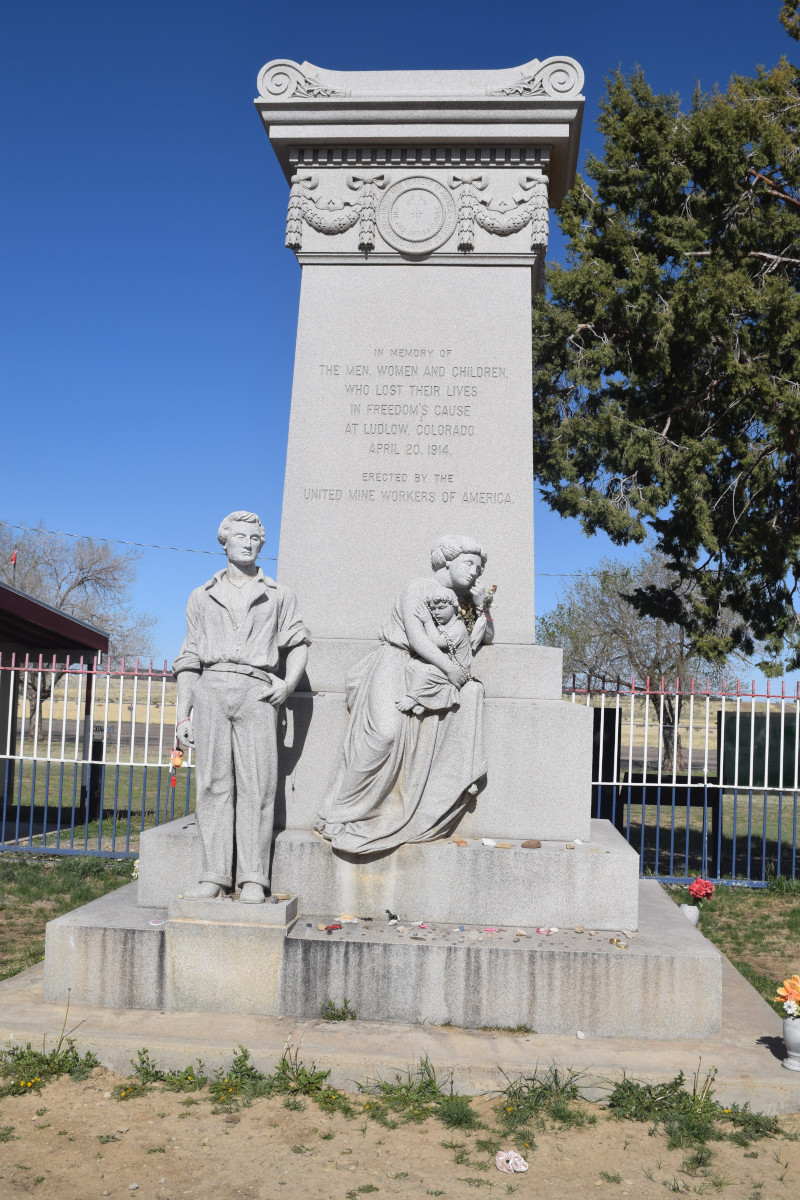
 We continued on our tour, visiting the Ludlow massacre site, a UMWA union monument. Someone had left a “Starbucks Workers United” button there, reminding us that unions are still fighting. We then finished driving back to La Veta. This was a good tour of the area.

Friday we drive to Mesa Verde National Park.


Sunday, January 23, 2022

Arizona to Colorado


Monday we left Tubac and went North on I-19, went east on a regular highway, and picked up I-10 east. We continued to the Hatch cutoff, and stopped in Hatch for lunch at B & E Burritos. We stopped into one of dozens of chili shops in Hatch, and bought some powdered chile. The Clerk told us that most people in Hatch are Mexicans, who work in the fields up and down the Rio Grande. We continued north on I-25 to Bosque Birdwatchers RV park, which was almost a 400 mile day. We dropped the rig and drove over to the viewing area, but did not see the thousands of Sandill Cranes that we had hoped for. The next morning we were there at dawn, and watched hundreds of snow geese, including some “blue morph” geese, who have dark bodies instead of the white of snow geese.


Sunset at Bosque de Apache National Wildlife Refuge


Tuesday we headed to nearby Socorro, where we visited the New Mexico Tech mineral museum, which had a bewildering collection of rocks, meteorites, petrified wood, and mining paraphernalia. The lady in the gift shop helped Sandi buy some rock books and small rocks for Jack. We stopped by the mission church, which recently celebrated their 400th year anniversary, but it was locked. 


 We continued on to Albuquerque, where we enjoyed the Indian Pueblo Cultural Center. Richard had been there years before, but the exhibits had been totally redesigned. Richard had a lengthy conversation with Jon Ghahate, who answered the “tribe or pueblo” question in a very roundabout way. He pointed out that the concept of nation states really dates from the 1700s, and the US was arguably the first nation state, as opposed to kingdom or city-state. The Spaniards referred to the indian villages as “Pueblos”, which is the Spanish word for cities. The Indians did not refer to themselves that way; each tribe had its own name for itself, in their native language. The Indian languages did not have a word that referred to all the Indians.  Sandi bought some earrings from an indian from Santo Domingo Pueblo.


We continued on to Santa Fe, where we camped at the Rancheros de Santa Fe, which is open in a very limited way during the winter months, but does have excellent wifi.  Sandi had work to do and needed good wifi.


Wednesday we drove to Las Vegas, New Mexico, where we visited the Plaza hotel on the main plaza.  When we stopped in the World Treasures Travelers Cafe, we found many weavings hanging, and a couple of looms; we spoke at length to Teresa, whose mother had run a weaving co-operative.  We saw her later on the street, speaking to another lady about a filming that was to be done that day.   Las Vegas is better preserved than most towns, and is often used as a setting for movies. At one point it was a railroad hub, and the largest town in New Mexico.


 We then went to visit the Castaneda Hotel, next to the railroad, which was a Harvey House hotel.  A developer had bought the Plaza and Castaneda Hotels and brought them back to their former glory.

We stopped in Raton, where Sandi took a business call.   I walked around and visited the local museum.  Raton seemed very run down, mostly empty storefronts, quite different than Las Vegas. We continued over Raton Pass to Trinidad Lake State Park, where we had a camping reservation.  The news from Northern Colorado was about an ice storm that hit Wednesday AM, so we wanted to let the ice melt before we headed home.   


Thursday we drove home, stopping in Colorado Springs for lunch and gas.  We arrived home mid-afternoon.   


Tubac, San Xavier de Bac, Saguaros

On Wednesday, after a little birdwatching, we left the campground around 10 am. We drove to Nogales, where we got propane at Tractor Supply, and continued north to Pilot, where we bought gas. We followed the directions to our campground; there were a lot of turns. The campground, Sunflower Camp, is as funky as we had expected, with the owner living in a geodesic dome, and the laundry a single washer and dryer, with an honor pay box. After getting set up, we drove to town, and had lunch at Shelly's, where there was a cowboy with a guitar singing. We then started visiting the art and craft stores. Some were more fine art, some were imports from Mexico, and many were mixed. Sandi bought at a couple of stores, including Mexican pottery from the Country Shop, and a kind of tile from Cobalt Fine Arts Gallery. We visited around twelve stores, perhaps visiting one third of the many shops. I was looking at the kinetic wind art, thinking about making a piece of my own. We shopped at the Tubac Market, and headed back to camp for dinner.


On Thursday, Sandi had a couple of business calls; I dropped her off at the library so that she had a good internet connection for a zoom call. After that we went to the Presidio at Tubac, where we again saw “Pixie”, who we spoke to at the Cobalt gallery. It was worth the time to see the complicated history of Tubac. The history of Tubac goes back to around 1750; De Anza left from Tubac when he went cross country to establish San Francisco. Apache raids were an ongoing problem. We had dinner at Wisdom restaurant in Tumacaccori. We came back to try to bird near the Santa Cruz River, but there were almost no birds to see or even hear. Sandi did laundry at the campground in the evening.


Friday, we headed for the Desert Museum in Tucson, where we saw more different cactus plants than we knew existed. We also saw Mexican gray wolves. We had lunch there, and enjoyed just walking around the grounds. We also learned that Saguaro cactus grow between 1000 and 4000 ft elevation, and do not like the bottom of valleys, as it can get too cold at night. There are four kinds of Desert in the US, the Sonoran, the Great Basin, the Mojave, and the Chihuahuan. The Saguaro cactus is the mark of the Sonoran desert.  We also saw their Javelina, which we had not seen before. All in all, a very worthwhile visit. 

 We continued on to the adjacent Saguaro National Park, where we did some hiking and saw more saguaros than we could count. We also hiked to some petroglyphs that were dated by style to the Hohokam culture of about 1000 AD. In most cases, petroglyphs are difficult to date, let alone interpret. We got back to our campground after dark.


Acorn Woodpecker


Saturday, we headed for Madera Canyon. We stopped at Santa Rita Lodge, where there is a bird watching area with many feeders. The Mexican Jays and the lesser goldfinches were there in force. We drove to the top, decided that the trails there were too steep, and drove down to the bottom, where we hiked next to the creek. There was another group with an birding instructor; she managed to see interesting birds in the trees, but we did not get a clear look at many of them. We came back to the lodge, where we were amused by a dozen turkeys, who had learned to jump up and bump the feeders to get food to drop on the ground. We also were able to see a pair of Hepatic Tanagers, a brightly colored bird which is relatively rare. We had a picnic lunch in the canyon, and then headed to the San Xavier del Bac mission, which was founded in 1692 by Father Kino. The current church was built in the late 1700s, and is the oldest European structure in Arizona. It is still an active parish, serving the O'odham tribe. .We finished the day visiting a few more shops in Tubac.

San Xavier de Bac

Sunday, we started at the cemetery, where we again saw many homemade monuments. We were surprised to see many graves just covered with a pile of rock, but we learned later that was the custom of the O'odham people. 


 Then we went to Tumacacori, another of the missions founded by Father Kino. This is a National Historical Park, declared so by Teddy Roosevelt. The buildings are partially restored; the grounds include an orchard of heirloom trees, a lime kiln, and a cemetery. The village was abandoned in the 1700 due to Apache raids. We chatted with Vincente, a potter connected to Mata Ortiz, who was at the park demonstrating; Sandi bought a couple of small dishes. 


 We returned to Tubac, where we again had lunch at Shelly's restaurant. We finished the day by wandering around Tubac; Sandi bought some yarn, and we stopped at a copper art studio, where Richard learned a few things.

Patagonia Arizona


After breakfast on Friday, we headed for the birding trail at Patagonia Lake State Park. We ran into a group of people with binoculars, who asked if we were joining the bird hike; we did not know that the hike was happening, but we joined. Mary was our guide; she is a volunteer who gets a free campsite for volunteering. The birders kept calling out birds that they saw; we probably did not see half of the birds named, but we did see some. We saw both a Northern Cardinal and a Pyrruloxia, a kind of desert Cardinal. We learned to identify the Scaup; distinguishing between the lesser and greater scaup was beyond our abilities. ;-) Sandi enjoyed seeing the Great Blue Heron, but the guide was disappointed not to see the less common Green Heron. We learned that there were birding boat tours in the morning, and decided to sign up.


We started listening to Patagonia KPUF, a real community radio station. The town also has a monthly newspaper, the Patagonia Regional Times, supported by donations and advertising.


We headed for the Patagonia Library, which we were told had the best free internet signal in town. Sandi had a business Zoom call, while Richard did internet research. Then we went to Gathering Grounds for lunch; they were short -handed, so service seemed slow, although the food was good. We had an outside table, and the people watching was interesting. Sandi noted that people around us seemed like us, older and educated. Patagonia is an old mining town, which is now more of an ecotourism destination, with birding the big draw. We also visited a couple of arts & crafts stores, and picked up beer and lettuce from the Patagonia Market. We came back to the campground, where we went to the visitor center and bought our tickets for the boat birding tour Saturday morning. We talked to a couple from Quebec, who had founded an organization dedicated to clean up of outdoor recreation areas, partnering with businesses. We talked to some other Canadians as well. There are more Coloradoans and Canadians at the campground than we might have expected. The campground was noisier and busier than the previous night, due to the weekend.


Saturday morning we went on the boat birding tour, led by Mary, with Roth driving. Mary pointed out many ducks, including Merganzers and Shovelbills. We had a mystery in that there was an animal in a tree that no one could identify. Our best guess is that he was a Coati, a kind of Racoon more common in Mexico, but we cannot be sure. 


 After the tour, we headed for town, stopping at the very interesting cemetery, with some graves decorated with seemingly random artifacts, such as rotary dial phones. Sandi thought that some of the graves must have been cosmic tolks. One grave was covered with mirror glass. There we many Hispanic names, and some graves with homemade markers; the photo is of a marker that includes horseshoes.


We visited the Paton Hummingbird center, where we saw a violet capped hummingbird, a rare bird indeed. We had “burros” at Pancho Villa's restaurant, and started walking. We stopped at Dia de los Muertos, where we heard about the woman artist who had created the store, and her remarkable son, focused on going good in the world. We stopped at the bakery and bought fudge, a bottle of wine, and some ice cream. They only had one loaf of bread left, but we learned that we could call and order bread. We have been very impressed with the local businesses. The bartender told us that a singer-songwriter would start playing in a few minutes, but we kept walking. We picked up some vegetables at Red Mountain grocery store, a cash only place, and headed back to the campground, where we picked up a permit to hike on Sunday.


Sunday we went for a hike on the Blackhawk trail, which took us across the spillway, down to the old railroad grade, and then back up the Sonoita creek trail, about 3 miles. Pretty but very dry, except near the creek. We had lunch at Common Grounds, where many of the customers were bicyclists. We spoke to the lady in the next campsite, who retired, sold her house, and is now full timing with a pickup truck and an Airstream trailer. She let me borrow her Oru folding kayak, which I found surprisingly light. I enjoyed paddling around the upper end of the lake. There were hundreds of blackbirds in the reeds, and a Great Blue Heron on a stump.


On Monday, we went on the bird hike with Suska, followed by a bird boat tour with Mary. The boat tour was windy, but we saw a flotila of Merganzers,, a couple of blue herons, a turkey vulture, a Phainopepla, a Pyrrholoxia, and some Ruddy Ducks and Northern Shovelers. After the boat tour, we headed for the Paton Hummingbird center, and again saw the rare violet crowned Hummingbird. We walked in The Nature Conservancy property, but did not see many birds, as it was the middle of the day. We had ice cream at Gathering Grounds, and bought some groceries at Red Mountain foods, where we talked to the manager, soon to be owner. We drove up to the old school, now a museum, and the office for Borderlands Restoration Network, which collects seeds.  There is a roadside shrine cut into the rock by the side of the road by the Telles family, fulfilling a vow from when their sons were in WWII.  People continue to leave offerings.


On Tuesday we headed for Nogales, AZ, and started with lunch at La Ley, a funky restaurant located on a side street between two auto shops. The reviews on Yelp and Trip Advisor were very good, but we were not impressed with the tacos that we had ordered. Perhaps if we had ordered something different we would have enjoyed it. We parked on the street near the old courthouse, and walked towards the border. There were many empty storefronts, perhaps due to the border closures. All the signs on the shops were in Spanish, no surprise. There was a binational hazardous material exercise on the railroad. Lots of banners, but not something open to the public. 


 At the border we talked to a border patrol agent, who told us that we could cross the border without a passport, just an ID and our vaccination cards. We had already decided that we were not going to cross. He took our photo, with the border wall in the background.   Note the razor wire.  We visited the museum in the old firehouse, but it was not as good as most local museums. The attendant told us that Nogales was created by the Santa Fe railroad, who built a line to the port of Guaymas, Mexico. We found some ice cream, and then tried to reach the border from the road to Patagonia. We got close, and our phones welcomed us to Mexico, but we did not reach the actual border.


Monday, January 10, 2022

Heading South

 Tuesday we started our trip by driving south on I-25 towards New Mexico. We stopped for fuel at Costco in Colorado Springs. It was a windy day, and the highway department had posted wind advisories. We decided to get off the highway, and wandered around Pueblo, visiting Pueblo Lake State park; the campground was on a point, so very windy. We stopped at the Steelworks museum, but found that it was closed for a new exhibit. We then looked at the weather forecast, and saw that the wind was going down, so we got back on the highway. We headed over Raton Pass into New Mexico, and stopped at the very funky Santa Fe Trail campground in Springer, right as it was getting dark. I was beat, and headed for bed about 7 PM! It is work to drive an RV with high winds.


I felt better on Wednesday morning, and we continued to head south. We stopped in Albuquerque for gas at Costco, and then picked up a good lunch at Vic's Daily Cafe, which the gas attendant had recommended. We stopped in Truth or Consequences, looked at the veteran's memorial, and took a hike down to the river. Like many towns in New Mexico, it had seen better days, when its hot springs were more popular. 


 We continued south to Caballo Lake State Park, where the campground host was nice enough to show us where we should go, and explain the reservation system. In New Mexico, the camping fee includes park admission, which is different from Colorado. Like Colorado, you have to make a reservation even if you are already in the campsite, and no one else is there. As Sandi was on the phone to the reservation desk, we heard and saw Sandhill Cranes flying overhead, probably headed to one of the wildlife refuges on the Rio Grande. Sandi was really happy and grateful to see the Sandhills. Our campground was pleasant and quiet; we took a brief stroll to a point overlooking the lake, which was glassy, reflecting the mountains.


Thursday morning, we heard the Sandhills again, and got on the road about 8. We bought gas in Demming, a truck stop at Road Forks, and then at the Love's gas station in Benson. Sandi had a business call, and we knew that cell coverage south of I-10 would not be great, so we stayed at Love's; I bought propane, ate lunch, and when her call was over we headed for Patagonia Lake State Park. We arrived at the lake about 3 PM, and were pleased with the campground and our campsite. It was shirtsleeve weather, very nice, at least until the sun went down. We met Bill Cotton, a retired CSU professor from Fort Collins, when Richard asked him about his wooden kayaks. Several other campers had brought kayaks. Richard kind of wished he had brought a boat. The WIFI at the visitor center is not working, but we have a couple of bars on our cell phones. We ate grilled salmon at the picnic table at our campsite.