Saturday, November 2, 2019

Ruins and villages


On Monday we went first to the ruins of Ollantaytambo, and the unfinished Temple of the Sun. The water system and ritual baths were very interesting. The hike to the top of the ridge was steep but short. The town was having a celebrations, with music and native costumes.

We took two hour bus ride up a switchback road to Accha Alta, to visit another textile village, at 12,800 feet in elevation. Lunch was at the village. These villagers do somewhat different types of weaving; a lot of shopping took place. We also received the skeins of yarn that we had helped dye. We made a stop at an overlook to see another ruin, and admired the alpacas. Many people live well above treeline.

We returned to the same hotel, the Taypikala Sacred Valley in Urubamba. Walking around the beautiful grounds, we saw a separate meeting room. We were told that they had Shamanic gatherings there.

Tuesday we started our day with a visit to the handicraft market of Pissac. We bought a few small things, including the two bulls and a cross found on the roof of many buildings here; the bulls represent the indigenous religion and Pachamama.

Sandi Shearing a llama
We continued to the village of Chauyatiri, at 12,460 ft elevation. There were a many weavers at work when we arrived, in their native costume. Sandi participated in shearing a llama with a knife. She also learned an edging stich from a young woman. 

Receiving line in village

Embroidered skirt


Sandi bought this piece

The lady teaching Sandi a stich

This village did not have electricity until 2017. It is amazing to see the houses on the hillsides, farming the terraces that may be pre-Inkan.

We visited briefly the ruins near Pisac; the most notable features were the terraces and the looted tombs cut into the hillside.

Thursday was a free day in Cusco. Sandi had meetings with the textile folks. Richard went to the regional museum; the most interesting thing was the rebellion of Tupac Amaru against the Spanish in 1780. This was a kind of Inka revival movement; Tupac had noble blood, and he is still an icon for native rights. Although the rebels had some initial successes, the rebellion was put down, and Tupac was quartered in the square in 1871. There is a huge mural in the museum depicting his execution.


When Sandi got out of her meetings, we went to the Maximo Laura museum and gallery, where we saw impressive tapestries with bright colors. One of Maximo's students was working on one of his pieces in the back of the gallery. We continued to the Inka museum, which had a special exhibit of Maximo Laura tapestries.

We saw many children and adults in costume for Halloween. The streets were crowded as we walked to our farewell dinner. We were headed to Lake Titicaca the next day. The rest of the group was going to Lima and then home.


Monday, October 28, 2019

Machu Picchu


Saturday morning we headed for Machu Picchu.

We had a luggage limit on the train, so we left some bags at the hotel. We took a bus ride to Ollantaytambo, where we found a busy train station. Our train arrived about 11 AM. We boarded our car, and sat in our reserved seats. We chatted with Martha and Thomas on the way, noting the change in climate and vegetation as the train continued down the river, losing altitude. When we arrived in Machu Picchu city (Aguascalientes), we gave our luggage to the hotel porters, and had lunch. We then boarded a bus for Machu Picchu.

The drive up to the site was on a switchback dirt road; we got glimpses of the mountain as we headed up. We arrived at the end of the road, and were able to enter the Machu Picchu site. Raul discussed the various theories about Machu Picchu, and pointed out different aspects of the site. It was a very good tour. We especially enjoyed the end of the day, when the crowds cleared out.


Our hotel, the Inkaterra, in Machu Picchu city (Aguas Calientes) was special, rooms spread out among the beautiful grounds. We took a walk to admire the birds and orchids. This area is a rain forest, so quite different from the higher elevations of the rest of the trip.


The llamas had the run of the place, and were pretty tame.

Sunday there were various options; we elected to go back to Machu Picchu. Sandi sat quietly in the plaza, and watched the clouds, while Richard hiked to the top of the Pyramid, to the Hitching Post of the Sun. The paths are laid out for one way traffic, so Richard had to ask the rangers how to get back to the top. They lifted the ropes for Richard to go up, and then to let Richard and Sandi go down. We shook the ranger's hand at the bottom, as he had let Richard go on a closed path. We spent some time at the cafe, which had a great view, and then took the bus down. We took the train back to Ollantaytambo, and the bus took us to our hotel in Urubamba.


Sunday, October 27, 2019

Cusco and the Gathering of Weavers

Cusco

On Monday, we got up early, and took a flight to Atlanta, and then on to Lima, Peru. It is a 6 hour flight, and we were tired. Our guide met us at the airport, and walked us to the airport Wyndam hotel.

On Tuesday, we ate breakfast at the hotel, and took an Avianca flight to Cusco. It was a bumpy ride over the mountains, and then a very bumpy landing on a 9000 foot runway. They had to partially depressurize the airplane, since Cusco is at 11,000 feet, and the airplane internal pressure is usually kept at 7000 ft. We can feel the altitude. We piled into vans to get to our hotel, Costa del Sol Ramada. We have a room on the top floor overlooking the rooftops, very nice. The hotel was built from a colonial home.

The afternoon was free; we walked a little, picked up a SIM card for my phone, and got cash from the ATM at the bank.


We had a nice welcome dinner at the Inka Grille.

Our twenty fellow travelers are from all over, Washington DC, Vancouver, Houston, Colorado, Phoenix, Idaho, and many more.. All have a passion for textiles and culture. Our guide, Raul, is excellent; his assistant, Alvaro, says he is getting a master class from Raul. Nilda, Raul's aunt, is the foundress of the organization which is working to preserve the Andean textile tradition, Centro de Textiles Traditionales de Cusco.
Raul and Alvaro


Wednesday we spent at the Centro de Textiles, with different groups learning different skills. I learned a semi-complex braid, after Nilda took me aside for one on one instruction. Sandi tried to learn to use a backstrap loom, but struggled, especially due to language barriers. The instructors were indigenous, wearing their fancy native costume. Sandi spent time in the museum and bought some gifts at the store. We had dinner with Alvaro, one of our guides, at Organika restaurant, a steep hike, including stairs, from our hotel. The street was named “Resbaloso”, which means slippery; we would not have wanted to walk it when wet. The food was amazing and surprisingly inexpensive.

Thursday we went to Pisaq, to attend a once a year gathering of the weavers from ten highland indigenous communities. There were about 200 people there, the vast majority in their colorful native costumes. There were numerous contests, including songs and riddles in Quechua, all related to weaving. At one point, our group performed Itsy Bitsy Spider, as our weaving song and performance. 

Many of the young women in their native costumes were carrying cell phones; it seemed somewhat incongruous.  
Sandi handing out coca leaves
Sandi and I were drafted to hand out coca leaves , which they chew as a treat. They would cup their hands, spread out a small weaving, or spread out their skirt to accept the leaves. It was like passing out Halloween candy to adults.

There were of course demonstrations of weaving with a backstrap loom. There were multiple techniques within that genre; we did not understand all the explanations of the different techniques. Towards the end of the day, there was time for people to play; they played soccer, skipped rope, spun tops, and played jacks, childhood games that are familiar to Americans. It was a joyous event; we were honored guests. At the end, we shook about 100 hands. The whole thing was really touching. It was quite amazing; we felt privileged to be there.


We had dinner at Ruicula, a farm to table restaurant, with most of the food coming from the Sacred Valley. This is part of the same business as Organika, where we ate the night before. We bantered with our adorable waitress. On our way back to the hotel, we watched folkloric dance and music performances by university students. All in all, quite a day.

Alvaro, Sandi, and others, pulling the skeins of yarn from the pot.
Friday was the natural dye workshop in Chinchero. It was a big event, with huge pots boiling over an open fire, with Nilda supervising with an iron hand. Between the dyes, chemicals, and the wood smoke, our lungs took a beating. We had lunch at a house across the street from their textile center, hosted by Raul's cousin. There was time for some shopping at the end of the day. We moved to the Taypikala Sacred Valley hotel in Urubamba, to be closer to the train station for Machu Picchu.

Monday, September 30, 2019

A Visit to North Park, Looking for Moose


On Monday, we hitched up the RV and headed for the redundantly named State Forest State Park. We stopped at the Moose Visitor Center and asked where to see moose. We had booked a very nice campsite looking out over North Michigan Reservoir, with a great view of the mountains. The campground is full of hunters with their off-road vehicles; we even saw one group with a small chest freezer on a trailer. We took a short hike to the other side of the lake. We drove around in the evening, all the way to Walden, hoping to see a moose, no luck. We did see a unique storm cloud, lit by the sunset. Richard had lived in Colorado forty years, and never seen a moose, even though he often visited this area.


North park, Jackson County, has only one town, Walden, population about 800. The valley or park is surrounded by mountains; the valley is mostly sagebrush, although there are wetlands, lakes, and Arapahoe National Wildlife Refuge. The primary businesses appear to be large cattle ranches, fishing and hunting. It is officially the moose capital of Colorado.

Cabin seen on hike

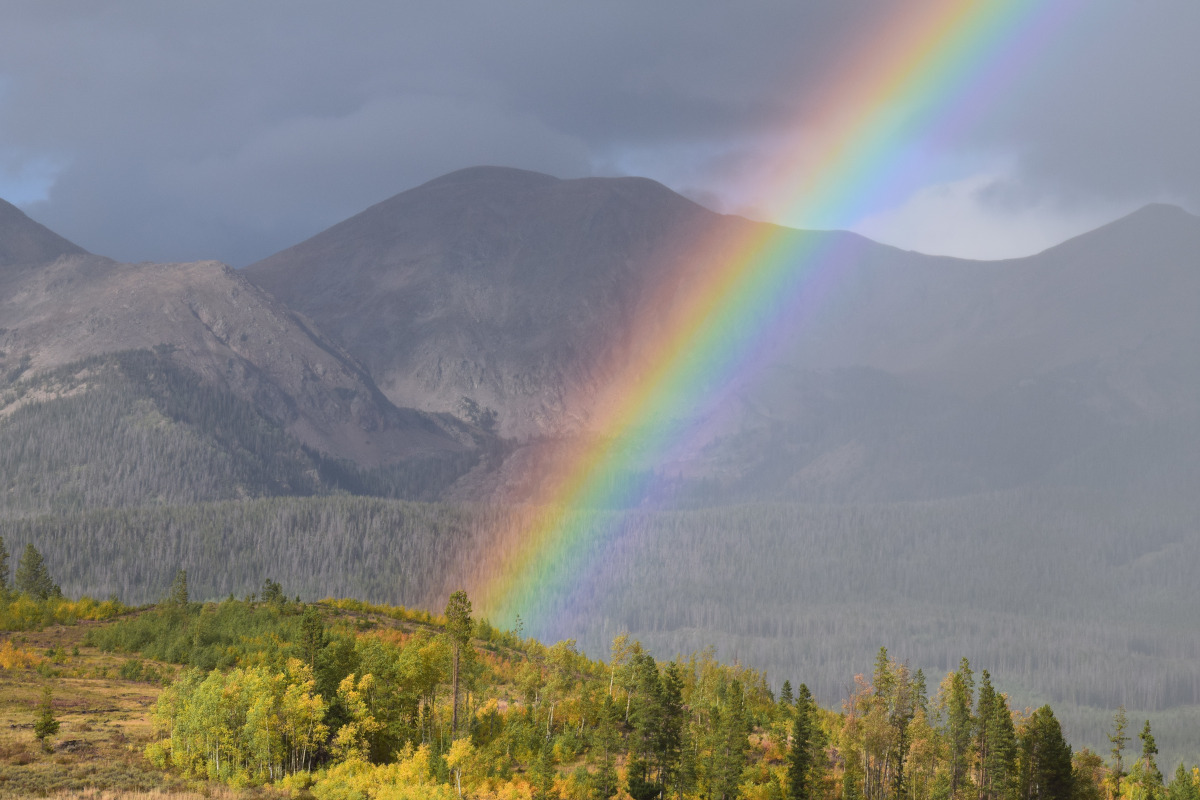
Tuesday, we stopped at the Yurt business, and met Suze, a local character. We learned that the yurts have outhouses and no running water. We started at the visitor center, and hiked five miles round trip in the direction of Ranger Lakes. We continued to look for moose. The occasional rain helped us decide to turn around, and we made it back to the car without getting too wet. We had lunch at the River Rock Cafe in Walden, which was full of hunters. After lunch, we visited the Pioneer Museum, which is a large museum full of donated objects of all kinds, including the projectors from the movie theater, now defunct. The museum is a history of the pioneer families of the valley, and a better than average museum of its type. On the way back, we saw a storm cloud dramatically lit by the sunset. Richard took a nap, and we got some great photos of a rainbow. Richard went fishing in the evening, and caught an 8 inch rainbow trout.


More ducks than you can count
Wednesday, we bought safety orange clothing, since it was hunting season. Then we drove to the Arapahoe National Wildlife Refuge, where we met the manager and only employee! She luckily had a group of volunteers during the summer months. We took a nature hike along the Illinois River, and then drove the auto tour loop. Each pond in the refuge was full of many species of migrating ducks, which Richard struggled to identify. Unfortunately, we had not brought our spotting scope. We came back, Richard took a nap, Richard fished for an hour, had some strikes, and Sandi finished her book. At sunset, we went for a drive to Cameron pass, where several people had mentioned there had been moose spottings. Just east of the visitor center, Sandi saw a large brown spot in the willows. Sure enough, we had seen our moose.

A moose!


Thursday we drove home

Wednesday, July 3, 2019

Boating on the Rideau Canal

On Thursday June 14th we headed for Toronto, on our way to the Rideau Canal.  We changed planes in Cincinatti, and checked into an airport hotel in Toronto.  We had dinner nearby.  The Toronto Raptors were playing for the NBA championship, and we watched the entire game, which was very competitive.

A brief history lesson:  The Rideau Canal was built around 1830, to help defend Canada from the Americans, after the war of 1812.  It runs from Kingston Ontario to Ottawa, the national capital, linking the Ottawa river with Lake Ontario.  It is a UNESCO world heritage site.   The canal has been in continuous operation for almost 200 years.

On Friday, we took the UP express train from the airport to Union Station in Toronto.  We wandered outside to find a beer garden, where we ate and listened to a young singer-songwriter, Sabrina Soares.  It was a happening place, and many people wore their Raptors bling.  We caught the train to Ontario, and got off at Smith Falls.  We took a taxi to the Best Western, and ate at the Roosterant, a local diner.

Our boat for the week
Saturday was rainy and windy. We dropped our suitcases at the Le Boat office, and walked around Smith Falls.  We started at the Rideau Canal museum, and proceeded to the Eastern Ontario Railway museum.  Richard ate the first cinnamon roll, one of many throughout the trip.  We were able to get on the boat about 3 PM.  Sterling walked us through the boat, which was large and very nicely appointed.   Due to the wind, we agreed to do our training run and launch on Sunday morning.   We made it to the 5 PM mass.

A lock at the entrance to the Tay Canal

Sunday started with some practice docking, and then we went through the first lock.  Sterling said goodby after the first lock, and we were on our way to Perth.  Sandi's ancestors were believed to have come to Perth after landing in Quebec.  We docked in Last Dual Park, where the last duel fought in Ontario took place.  Perth was quiet, with most stores closed.  We visited the historical society and tourist information center.   Richard took a photo of Sandi with the mammoth cheeze.  We strolled along the river, and visited a few shops.

Monday we walked into Perth, and were at the library when the doors opened.  We went through some archival information, but did not find her family's name.  Richard had another cinnamon roll, and we headed back down the canal, aiming for Westport.  We made it to the narrows lock just in time to be the last boat locked through for the day.  Westport has an island with docks on it, and a pedestrian bridge to the mainland.  We were able to buy groceries before the store closed; everything closes about 5 PM.

Tuesday morning we paid our docking fee, and headed for Chaffee's lock.  We found a place to dock near the lock.  A lockmaster and another boater helped us tie up.  Wayne, the boater, was a wealth of local information.   We walked over to the Opinicon resort, and made a reservation for dinner.  We enjoyed watching the world go by, including the wealthy lady who rescued and restored the Opinicon, a historic fishing lodge.  The grounds are beautiful; the ice cream shop was a nice touch.   We had dinner in the dining room, and walked around the resort.  The cabins have been fully modernized, but kept their turn of the century charm.

Opinicon
Wednesday we decided to head for Colonel By Island, a Parks Canada island named for the man who led the effort to build the canal. At the narrows lock, we experienced a little of the wind that sometimes shuts down the lock.  The lockmaster said that he had locked through several trawlers in the last couple of days, headed to the island, and suggested that we would find no space for our boat.  We decided to stop by the island and check it out. It was a bit of a challenge to navigate into the group of islands, with numerous shallow areas, without any navigation buoys. When we arrived, we found only one other boat, so we pulled into the dock.  The other boater helped us tie up, and said that the trawlers had left in a group that morning.  We took a hike around the island, where we saw many trees in strange shapes due to a 1985 tornado.  A couple of small boats stopped for a brief visit, but otherwise all was quiet.  We enjoyed a good dinner on the upper deck.  We were serenaded by the haunting cry of the loon.   As it got on to evening, the wind died, and it was very quiet.


On Thursday, the rain started as we set off.  Our first challenge was to navigate out of the group of islands into the main channel. Our next challenge was visibility, as the defroster did not work. Sandi kept wiping the windshield.  We found our way to the entrance of the Tay Canal, where we chatted with the friendly lockeeper, who seemed unaffected by the rain.   We heard about a fallen tree blocking the canal.  From the upper lock, we saw the fallen tree, and decided not to proceed until the lockeepers had cleared the channel.  They tried to clear it with a kayak, but ultimately had to go get a saw to remove the tree.

We called Le Boat about our defroster; they walked us through the switches, but ultimately told us to pull the fuses to reset the heater.   After we were safely at the dock in Perth, we were able to pull the fuses, and get the heater working.

We strolled into Perth, and first hit the library, where Sandi was able to take care of some business.  We then stopped at Coutts Coffee for a warm drink and a sweet.  We visited the Book Nook, where Richard bought a mystery by the well known Canadian author Louise Kenny.   We had a lengthy chat with the owner of the Irish/Scottish shop, who was pleased that Richard knew how to pronounce Donegal.  We stopped by the visitor information center, where we met Debbie, the archivist, who may be able to help Peg tracking down family history.   Finally, we had dinner at O'Reilly's Pub, where we enjoyed the fish and chips special.  By that time, the rain had stopped, and we strolled back to the boat.
Tay canal

Friday we strolled into Perth for coffee and sweets.  We headed back to the locks, enjoying once again the wetlands around the Tay River, and the Great Blue Herons that we saw.   The lock crew was training summer help.  When we got to the lake, it was windy, and the wind made it more difficult to keep a course.  We went through two more locks; the lock at Smith Falls had a dozen students being trained for the season.  We gingerly backed the boat into a space between two other boats.  Sandi did laundry; Richard cleaned the upper and lower decks of the boat.  We had a nice dinner at Whim restaurant.   We are tidying up the boat to give it back on Saturday morning; we will be checked out at 8:30, with a taxi at 9, and a train to Toronto at 9:30.

Saturday we took the train to Toronto, and a taxi to the Clinton and Bloor B&B in the Koreatown neighborhood of Toronto.  We decided to head downtown for the Toronto Jazz Festival, which was on Sandi's life list.  We saw several bands; the best was the Hot 8, a brass band from New Orleans.  We had dinner at a taco place near our B&B, Asados.

Sunday morning we had breakfast at the B&B, and went to mass at 11:15.   There was an indigenous event at Fort York, and we took a streetcar to get there.  We participated in the event, mostly by drumming in a group.   We strolled down to the water, and then took the streetcar to the Kensington neighborhood, which was downright funky, kind of a cross between Greenwich Village in its heyday and Key West.  Lots of young people strolling around, and people with rainbow colors from the Pride parade.  We visited a couple of used bookstores on our stroll back to the B&B.  We had dinner at a Korean BBQ place suggested by our host, Albert.

Monday, Richard flew home, and Sandi went to work.  We had a great vacation.

Sunday, June 9, 2019

The Escalante River - Hard Work


Friday May 24th we drove to the town of Escalante, Utah.  I rode with Roger, Debbie rode with Randy.   We stayed at the Escalante campground across from visitor center.  We had dinner at Circle D restaurant.

Saturday we drove to Egypt trailhead. Amazingly, someone volunteered to carry two loads down the hill for us!!  We walked down, but got off trail, and ended up in canyon, when we should have been on the ridge. Debbie and I dropped our packs at 2/3 point, headed back to the trailhead, and ran shuttle. We both had awful heavy packs on the way down; I arrived at camp at dusk, exhausted. Everyone was tired, so we did no cooking.

Sunday AM we packed boats, got on the water about 11:30. Randy and Debbie experimented with loading their packrafts.  The river was nice, with some scraping and maneuvering. We made the short hike to the Golden Cathedral in Neon canyon.  We camped on the bar across from 25 mile canyon.
Randy, Roger, and Debbie

Monday. The weather was nice at first, then hard rain and wind. We saw many waterfalls. I started to get hypothermia by Baker canyon, shivering, so we stopped and set up my tent.  I should have brought my dry suit; the inflatable kayak is a colder and wetter boat than my canoe.  The side creek ran high. The rain stopped in the evening.

Scorpion Rapid
Tuesday was partly cloudy and warmer. We had some adventures. I fell out of my boat once. At Scorpion rapid, our plan was to eddy out left.  I was first and did that.  Roger eddied out a bit upstream. The rapid looked crazy to me. There were people on shore urging us to run it. Amazingly, everybody disregarded the plan and followed the advice of people we did not know. Randy flipped and his boat disappeared downstream. Roger flipped at the end.  I portaged, and still flipped on the lower section. We headed downstream, hoping to find Randy’s boat and gear, and making contingency plans. Miraculously, we found the boat half a mile downstream. We headed for George’s camp at mile 57, but ended up across the river.  9 miles today, a good number on this river.  The rangers came to camp around 7:30, and we invited them to stay, which they did. Their packs were impressively small. We pumped them for information.

Wednesday the river was down a few inches, and we scraped a lot.  Sometimes it felt like we were the ball in pinball.  The mandatory portage was a lot of work, perhaps 75 yards. We camped across from Fools canyon, a good camp, but not a good takeout. We made 10 miles.

Steven's Arch

Thursday. The weather was warmer and drier.  The river was down a little more. We got on the river earlier. There was some running aground, and pinballing off rocks. We got to Coyote Canyon about 1 PM, and walked up the stream bed to camp, 5 minutes up the canyon.   I scouted the route out; to get out of the canyon involves scrambling on downsloping rock and sand, with significant exposure.

Another party hauling packs at the crack

Friday. We left camp around 8. On the rock section, I ended up shuttling everyone's pack. The hike to Crack in the Wall was brutal, heavy loads, multiple carries, uphill on sand, the hottest day of the trip, and we ran out of water.  Crack in the wall was a bit of a social event, groups cooperating to move loads through that section, including ropes.

Richard in crack
Looking down from Crack in Wall

We left much of the gear at the top of the canyon, to be carried the next day.  We all agreed that it was the hardest day we could remember. Everyone was exhausted.    We spent 11 hours hauling gear, and camped in the parking lot.

Tha last part of the hike out
Saturday. We spent 8 AM to 1 PM hauling gear back to car. So it took us 16 hours of work to haul our boats and gear out of the canyon.  We stayed in Escalante at Circle D motel, with dinner at the restaurant. We took a stroll down main street; many of the buildings had historical markers on them.

Sunday - We had breakfast at the Circle D, and drove home without incident.

After the trip, there did not seem to be much enthusiasm for pack rafting, partly because we would all need new ultralight gear, in order to be able to haul in a single load.   The double hauls mean that you have to travel three times the distance.   People liked the river, but would not come back if we had to hike in and hike out.